

Machines and Agentic AI systems now drive most of the traffic across modern enterprises, with machine-to-machine communication underpinning everything from backend processes to CI/CD pipelines. Every one of these interactions depends on authentication, and that means secrets.
As this shift accelerates, so does secrets sprawl. API keys, tokens, and credentials end up reused across staging, production, dev environments, and automation scripts—untracked, unmanaged, and often invisible.
This behavior directly violates OWASP’s NHI Top 10 Risk #2: Inadequate Separation of Environments, which highlights the dangers of reusing secrets across environments.
GitGuardian detected over 12.8 million secrets exposed on GitHub in 2024 alone. We saw that private repos are even more prone to exposure. Inside organizations, things are very fragmented. Secrets are often scattered across at least six different vaults, thanks to ‘vault sprawl’ and Shadow IT. Mapping a single secret can take days—if it can be done at all.
In this blog post, we’ll look at a common but high-risk use case: a shared secret reused across production and staging. This breaks isolation boundaries and significantly raises the risk of lateral movement during a breach. We’ll explore how GitGuardian and Akeyless work together to identify and resolve this kind of threat, closing the gap where traditional secrets managers fall short.
Why This Cross-Environment Usage Is Dangerous
This seemingly simple act creates significant vulnerabilities, primarily due to:
- Inconsistent policies & reusage: A secret rotated in one environment often remains unchanged in others. This duplication leads to outdated credentials and opens up production systems to unnecessary risk, dramatically increasing the “blast radius” if a single reused secret is compromised.
- Lack of visibility & control: Teams often lack a unified view of where secrets reside, who owns them, or their usage across various environments. This fragmentation makes centralized governance and an effective secrets inventory nearly impossible.
- Operational burden & risk: Manual processes for managing secrets across disparate environments are error-prone, time-consuming, and can lead to insecure storage (e.g., in spreadsheets). This directly impacts developer workflows and complicates incident response, as context about a secret’s usage across environments is often missing.
- Neglected rotation & JIT secrets: Despite their critical importance, the complexity of secrets sprawl means that automated rotation and Just-in-Time (JIT) access for secrets are often neglected. This leaves long-lived, over-permissioned credentials vulnerable, a prime target for attackers, enabling lateral movement and escalating breaches.
GitGuardian + Akeyless Integration
In our discovery interviews, 100% of organizations admitted they don’t know how to build or maintain a secrets inventory, and none could quantify how many secrets they manage.
This is where GitGuardian NHI Governance shines. It delivers comprehensive discovery, fully mapping your organization’s entire secret and NHI landscape across every layer of your infrastructure.
Here’s how:
A Centralized, always-current inventory
GitGuardian builds a single source of truth by continuously discovering and tracking every secret across environments, teams, and tools, finally giving organizations the clear inventory they’ve been missing.
Comprehensive discovery spans well beyond your codebase. GitGuardian scans:
- Primary Sources: Secrets managers like Akeyless.
- Cloud Infrastructure and Deployment Tools: Kubernetes clusters, Terraform files, and states to map where secrets are used and consumed.
- Context Sources: Databases and third-party SaaS apps (e.g., Stripe, Slack) where secrets and permissions originate.
Deep context and lifecycle awareness
Discovery without context is noise. GitGuardian provides a 360° view of every secret, including:
- Who introduced it, when, and where it lives
- Which NHIs (scripts, apps, services) does it belong to
- What systems does it connect to, and what permissions does it grant
- When it was last used or rotated, and whether it’s still needed
This enables teams to identify overprivileged identities, “zombie credentials,” and secrets with high blast radius—so they can prioritize what matters most.
Strengthen Secrets Posture with Akeyless: Secure, Centralize, Automate
Akeyless complements GitGuardian by taking detected risks and translating them into concrete security actions—eliminating exposed secrets and preventing recurrence through automation, policy enforcement, and runtime security. Once GitGuardian surfaces a secret reusage or exposure, Akeyless ensures that the secret is never hardcoded again.
1. Centralize and Govern Secret Usage
With Akeyless as the centralized secrets management platform, organizations can replace static credentials with secure references and enforce consistent policies across environments. Akeyless acts as the single source of truth, enabling unified control over access permissions, versioning, and audit logs—all backed by a zero-trust architecture where even Akeyless can’t see your secrets.
2. Enable Just-in-Time Secrets and Dynamic Access
Akeyless supports Just-in-Time (JIT) credentials and dynamic secrets for cloud services, databases, and more. This dramatically limits the exposure window for secrets: credentials are generated only when needed and expire moments later. Even if exposed, they’re rendered useless. This eliminates the risk of long-lived credentials being detected by tools like GitGuardian in the first place.
3. Automate Rotation and Break the Reusage Cycle
Secrets reused across environments typically go unrotated because manual updates are cumbersome and error-prone. Akeyless automates secret rotation and propagation across all environments. Whether it’s a database password or a cloud IAM token, rotation is fully synchronized, so once a secret is changed, it’s changed everywhere.
4. Empower DevOps with Secretless Workflows
For true defense-in-depth, Akeyless enables secretless authentication using trusted identities like AWS IAM roles or GitHub OIDC, removing secrets from pipelines entirely. This aligns with GitGuardian’s mission to detect exposed secrets, but takes it a step further by eliminating the need for secrets where possible.
How It Works
Here’s how a typical workflow unfolds using GitGuardian and Akeyless together:
Step 1: Detect Cross-Environment Secrets with GitGuardian
GitGuardian detects a sensitive API token present in both your production and staging repositories. It instantly flags the reusage of secrets, alerting your security and DevOps teams.
- You see precisely where the secret lives (e.g., prod.yaml, staging. env)
- You know who introduced it
- You understand the potential impact through GitGuardian’s risk scoring
GitGuardian provides the critical visibility to uncover these exact scenarios.

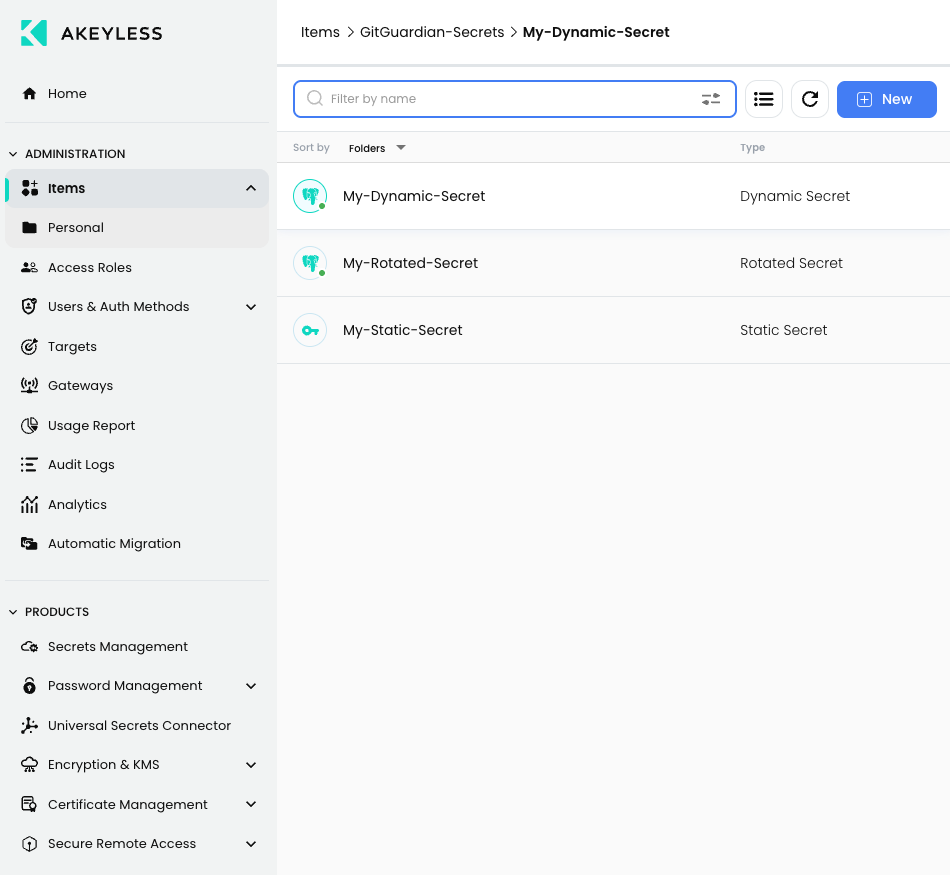
Step 2: Establish a Single Source of Truth with Akeyless
Once GitGuardian surfaces a reused or exposed secret, Akeyless steps in to remediate and future-proof your infrastructure securely. The detected secret is migrated into the Akeyless platform, replacing static, hardcoded values with secure, centrally referenced secrets. This isn’t just a cleanup—it’s the foundation for scalable, secure secrets governance. From this point forward:
- Reusage of the secret is eliminated: Akeyless consolidates secrets into a unified, SaaS-delivered vault that supports hybrid and multi-cloud environments.
- Access becomes tightly governed: With robust RBAC/ABAC policies and native integration with identity providers (e.g., Okta, Azure AD), access to secrets is granted on a strict need-to-know basis.
- Audits are streamlined: All secret access and activity are logged in real-time and exportable to SIEM systems like Splunk, Datadog, and Elastic for compliance and operational insight.
- Security is uncompromised: Thanks to Akeyless’s Zero-Knowledge encryption architecture, powered by patented Distributed Fragments Cryptography® (DFC), Akeyless never has access to your secrets.
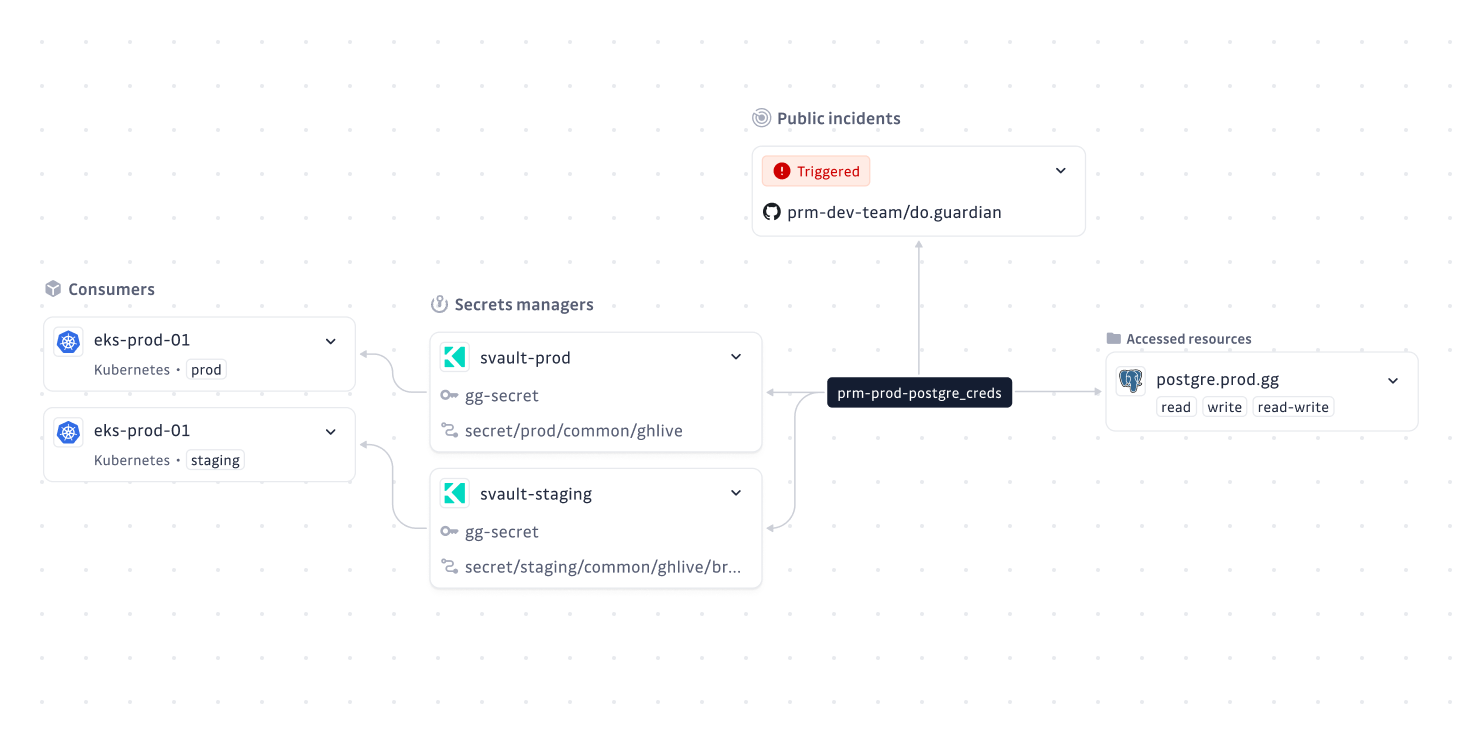
Step 3: Visualize Secrets Usage with GitGuardian’s Secrets Map
GitGuardian’s interactive secrets map gives you a unified view of where secrets are used across your infrastructure. This helps you:
- Confirm cleanup actions
- Understand complex secret dependencies
- Coordinate cross-team response effectively
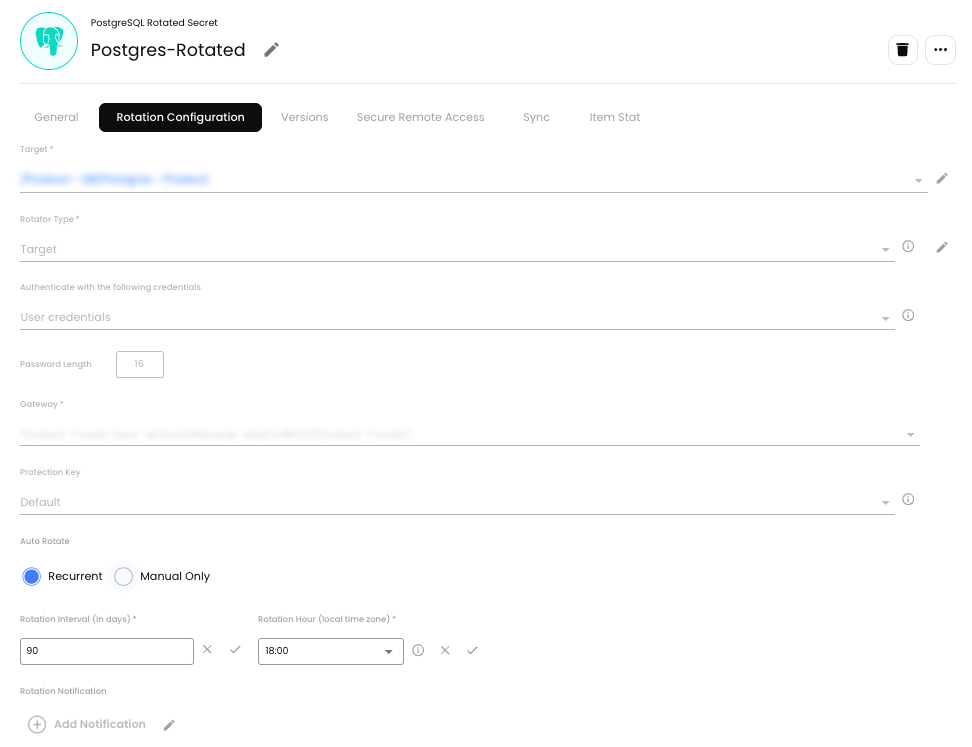
Step 4: Automate Secret Rotation with Akeyless
Akeyless automates the rotation of the compromised or duplicated secret and pushes the new value across all connected environments, including production, staging, CI/CD pipelines, cloud platforms, and more.
With Akeyless, rotation becomes a reliable, invisible background process, ensuring that:
- Every reference to the secret is instantly updated
- DevOps teams don’t need to hunt down and manually replace secrets
- Rotated secrets are short-lived or JIT-generated, limiting risk exposure
- GitGuardian is automatically updated as legacy hardcoded values disappear from the codebase
💡
Together, GitGuardian and Akeyless create a continuous feedback loop: detection leads to remediation, remediation triggers rotation, and rotation is verified by continuous scanning. The result is proactive, automated secrets hygiene that eliminates blind spots and lateral movement risk.
Visibility + Action = Security
GitGuardian and Akeyless together solve the full secrets management equation:
- Visibility across the full lifecycle
- Security through rotation and centralized management
- Automation with just-in-time (JIT) access and secretless workflows
- Consistency across all environments
No more blind spots. No more reusage of secrets. Just full control. End-to-end.
Next Steps
Explore how GitGuardian and Akeyless can help your team:
- Detect, secure, and rotate secrets with confidence
- Reduce mean time to remediation (MTTR) for exposed credentials
- Implement best practices like JIT access, zero standing privileges, and secretless deployments











