

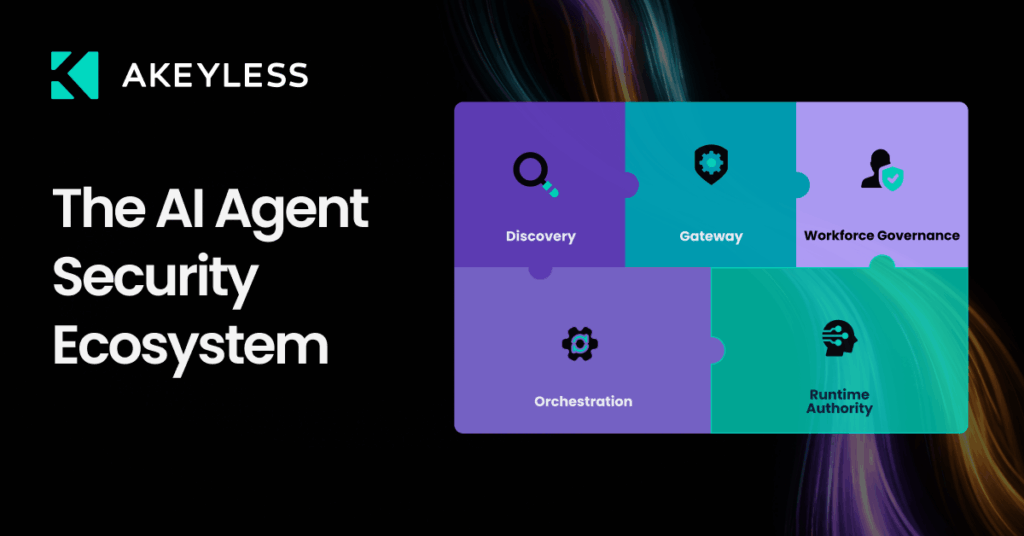
Quick summary: As enterprises deploy AI agents, an entirely new security ecosystem is emerging. AI discovery platforms, MCP gateways, workforce AI governance platforms, automation platforms, and runtime authorization solutions all promise to secure AI agents—but they solve fundamentally different problems. Understanding where each category fits is becoming just as important as choosing the right products.
This article explains the role each category plays, how they complement one another, and where Runtime Authority fits into the overall AI security architecture. It is intended for security architects, platform teams, identity teams, and AI engineering leaders evaluating how AI agents should securely access production systems.
The Landscape in Three Sentences
Most of the agentic AI security tools on the market today fall into one of two buckets. Discovery platforms tell you what your agents are doing: which ones exist, what they’re touching, and how risky that looks. Gateways control which tools and traffic agents can reach: they sit in front of MCP servers, LLM providers, or APIs and apply routing rules. Akeyless Runtime Authority does a third thing, it decides whether each individual action can happen at all, brokering the request through a Gateway where the credential needed to complete it is minted just-in-time and never exists anywhere else.
All three answer a real question a security team has to ask. But only the third sits directly in the access path, owns the credential lifecycle, and validates the intent of a request before anything executes against a production system. That’s the layer where agent risk actually gets removed rather than just reported or routed.
Why This Distinction Matters
The vocabulary across this space overlaps heavily, control plane, runtime, governance, agent identity, audit, making it easy to assume these tools compete head-to-head. In practice, most solve a different problem than credential elimination and per-action intent enforcement:
| Category | Example | Primary Responsibility |
|---|---|---|
| AI Discovery & Oversight | Onyx, Prompt Security, Protect AI, Zenity, Lakera, HiddenLayer, Palo Alto Networks Prisma AIRS, Microsoft Defender for AI, and Cisco AI Defense. | Discover AI agents and assess risk |
| MCP / AI Gateway | Lunar, Portkey, Kong AI Gateway, Gravitee AI Gateway, Solo.io kgateway, Cloudflare AI Gateway, Zuplo AI Gateway. | Route and govern AI traffic |
| Workforce AI Governance | Willow, Glean, Moveworks, Writer Enterprise | Govern employee use of AI tools |
| Agent Automation & Orchestration | Workato, MuleSoft, Boomi, Tray.ai, Microsoft Power Automate, UiPath, ServiceNow AI Workflows. | Build and orchestrate AI workflows |
| Runtime Authority | Akeyless | Authorize AI agent actions |
If a vendor talks about inventory, shadow AI, posture scores, and compliance dashboards, it’s a discovery platform. If it talks about MCP catalogs, tool routing, and key management at a choke point, it’s a gateway. Neither is enforcement in the sense of removing the standing credential and validating what a specific action is trying to do before it happens, and that’s exactly where the two categories genuinely need what Runtime Authority provides.
The emergence of AI agents changes the security model. Traditional applications execute predefined logic, while AI agents make decisions at runtime, invoke different tools, and access multiple systems based on natural-language prompts. That means security can no longer rely solely on authentication, standing permissions, or post-event monitoring. Organizations need a runtime enforcement layer that evaluates every requested action before it reaches production systems.
With that framing in place, here’s how four tools teams commonly evaluate alongside Akeyless actually fit.
AI Discovery Platforms: Discovery Tells You. Enforcement Removes It.
Onyx is one example of a broader category of AI discovery and observability tools, a category that also includes names like Prompt Security, Protect AI, Zenity, and Lakera. Nearly everything below applies to that category as a whole, not just to Onyx.
Onyx positions itself as a secure AI control plane focused on observability: discovering sanctioned and shadow agents, scoring their risk, detecting threats like prompt injection, and reporting on compliance and adoption. It’s genuinely useful, a security team gets a map of its AI estate and a risk register.
The gap is structural. These platforms watch activity; they don’t sit in the access path. The agents they observe keep whatever standing credentials they already had, the platform flags the excessive ones, and each flag becomes a remediation ticket for someone else to close. Their runtime defense is detection and response: by the time a risky session is spotted, the agent already held the access that made it dangerous. And a discovery-driven model has to find an agent to protect anything from it; an agent it never discovered is simply ungoverned.
Their findings — over-permissioned agents, exposed data paths, standing secrets — describe exactly the conditions Runtime Authority is built to remove. An enterprise running any of these tools still needs a layer that takes each flagged finding and actually eliminates the standing credential behind it, validates the intent of the action before it executes, and masks sensitive data before it reaches an agent’s context window. These platforms and Akeyless are complementary far more than competitive: one finds the risk, the other closes it.
MCP Gateways: A Gateway Manages Keys. Runtime Authority Removes Them.
Lunar is one example of a broader category of MCP and AI traffic gateways, a category that also includes Portkey, Kong AI Gateway, Gravitee AI Gateway, Solo.io gateway, Cloudflare AI Gateway, and Zuplo AI Gateway. Nearly everything below applies to that category as a whole, not just to Lunar.
Lunar is an enterprise MCP and AI traffic gateway, typically self-hosted inside the customer’s own environment, that observes and governs MCP, LLM, and API traffic through a single choke point. It offers real strengths: full lineage from user to agent to model to tool, an admin-vetted MCP catalog, a pre-deployment risk sandbox, and granular, time-bound access rules.
Architecturally, these gateways sit close to Runtime Authority, both are choke points an agent’s requests must pass through. The difference is what happens inside that choke point. A gateway stores and manages the API keys and OAuth grants behind its connections: hidden from the agent, but still standing, stealable objects at the gateway. Its access rules are granular and time-bound, but they’re rules about which tool an identity may reach, not a semantic read of whether this specific request matches what the human actually asked for. A rule can’t distinguish “read a row” from “drop the table” when both are permitted operations on an approved tool. Its coverage is also the traffic that chooses to flow through it — typically MCP and API calls — not the direct paths agents may take into databases, Kubernetes clusters, or cloud provider APIs.
Hiding a key is not the same as eliminating it, and a time-bound rule is not the same as evaluating intent. A team running an MCP gateway for traffic governance still needs a layer where credentials are minted just-in-time and destroyed after use, where each request’s intent is checked against the originating prompt before a secret ever exists, and where non-gateway paths into infrastructure are covered too.
Workforce AI Governance: Permissioning Tools Isn’t Governing What Agents Do Inside Them
Willow is one example of a broader category of workforce AI enablement and governance platforms, a category that also includes Glean, Moveworks, and Writer Enterprise. Nearly everything below applies to that category as a whole, not just to Willow.
Willow (by Webrix) is a workforce AI enablement and governance platform built around discovering shadow AI, giving agents an identity derived from the corporate IdP, applying role-based permissions to tools and skills, and offering a curated, self-serve marketplace of approved connectors and MCP servers. It’s a strong answer to a real adoption problem: how do you roll AI tools out to employees safely and know what’s being used.
These platforms’ governance model, though, is permissions and conditions on tool access, not control of the credential lifecycle or the specific action taken once a tool is approved. The OAuth grants and connector credentials behind the platform remain standing objects. Approving a tool for a role also says nothing about whether a particular request, in the moment, matches what the human actually intended, an approved agent using an approved tool can still take a destructive action inside it.
These platforms answer “which tools may this identity use.” They don’t answer “what is this agent about to do inside that tool, right now, and does it match the human’s prompt.” An organization running one of these platforms to roll out AI safely to its workforce still needs a runtime layer underneath: one that removes standing credentials entirely, evaluates intent per request, and extends the same audit pipeline that already governs human and machine privileged access to these newly enabled agents.
Agent Orchestration Platforms: A Different Layer Entirely
Workato is one example of a broader category of integration and automation platforms (iPaaS) that build and orchestrate agents, a category that also includes MuleSoft, Boomi, Tray.ai, Microsoft Power Automate, UiPath, and ServiceNow AI Workflows. Nearly everything below applies to that category as a whole, not just to Workato.
Workato is an integration and automation platform that builds and orchestrates agents across a large connector library, with governance features layered on top of its own traffic: role-based access tied to an authenticated user’s identity, and request/response logging. It answers a different question than either discovery or gateway tools: not “what is risky” or “what may reach what,” but “how do I get agents to actually do the work.”
That makes these platforms complementary rather than a substitute for a security layer. Their governance is scoped to the integration layer they operate, is role-based rather than intent-based, and their trust model requires application credentials to live inside the platform, with agents acting through those stored connections. An execution platform can add governance features to the traffic it carries, but it can’t be an independent security control for itself and for every other agent framework running elsewhere in the enterprise.
These platforms are worth keeping for what they do well — building and running agentic work across SaaS applications. But the agents they build, and any other agent framework in use, still need a runtime layer underneath that removes credentials from the trust chain, validates intent per request, and covers the systems — databases, Kubernetes, cloud APIs, legacy infrastructure — that sit outside any connector library.
The Pattern Across All Four
Discovery, gateways, workforce AI governance, and agent orchestration all solve important problems. Runtime Authority is different because it governs the moment where risk actually materializes: when an AI agent attempts to perform an action against a production system. That’s why these categories are usually complementary rather than mutually exclusive.
Whether a tool discovers agents, routes their traffic, governs which tools they may use, or builds and orchestrates them, the same gap shows up: none of them removes the standing credential from the agent’s path, validates the semantic intent of a request before it executes, masks sensitive data before it reaches an agent’s context window, or unifies agent activity with the audit pipeline that already governs human and machine privileged access. That’s not a knock on any of these tools — each does its own job well. It’s a different layer of the stack: the one where agent risk is actually removed rather than observed, routed, or permissioned.
Runtime Authority extends Modern Privileged Access Management (PAM) principles from human and machine identities to autonomous AI agents. Instead of granting standing access, it brokers just-in-time, intent-aware access to production systems and applies the same governance, policy enforcement, and auditability security teams already expect for privileged identities.
If your organization already runs — or is evaluating — a discovery platform, an MCP gateway, a workforce enablement tool, or an automation platform for building agents, that’s a reasonable and often necessary piece of the puzzle. It’s also, in each case, not the piece that decides whether a specific agent action should be allowed to happen, with a credential that never exists outside the moment it’s needed.
See It in Action
See how Runtime Authority works alongside AI discovery platforms, MCP gateways, and agent frameworks to broker just-in-time access, validate intent, and eliminate standing credentials. Request a Runtime Authority demo to see it work alongside the tools you already run.











