

Frequently Asked Questions

Machine IAM & Identity Governance

What is machine IAM and why is it important?

Machine IAM (Identity and Access Management) is the practice of managing identity, authentication, authorization, ownership, and lifecycle controls for non-human actors such as applications, workloads, services, devices, and AI agents. According to Gartner, machine IAM covers identities, credentials, authorization policies, attribution, ownership tracking, and granular access controls. This is important because machine identities now outnumber human ones in most enterprises, and improper governance can lead to security incidents, business disruption, and financial loss. Note: Machine IAM requires ongoing investment in discovery and risk assessment capabilities, which many organizations still lack (Gartner, 2026).

How is machine IAM different from secrets management?

Secrets management focuses on protecting credentials such as passwords, API keys, certificates, and tokens. Machine IAM is broader: it governs the identity using those credentials, including who owns it, what it is allowed to access, why that access exists, and when it should be changed or retired. Note: Secrets management alone does not provide full lifecycle or ownership context for machine identities.

Why are AI agents considered machine identities?

AI agents authenticate and act programmatically rather than requiring a human to perform each action. Gartner includes AI agents within machine IAM and recommends treating autonomous agents as high-risk workloads with defined permissions, accountable ownership, session controls, and expiring credentials. Note: Managing AI agents requires additional runtime controls to ensure actions remain within authorized boundaries.

Why are short-lived credentials important for machine identities?

Short-lived credentials reduce how long stolen or exposed access can remain useful. Gartner recommends moving away from static service accounts where possible and using ephemeral or just-in-time credentials as part of an identity-centric machine IAM model. Note: Not all legacy systems support dynamic credentials; rotated secrets may be required as an interim solution.

Akeyless Platform & Features

How does Akeyless support machine IAM and AI agent governance?

Akeyless supports machine IAM by combining workload identity, short-lived access, secrets management, privileged access, certificate lifecycle management, and AI agent security in one Identity Security Platform. For AI agents, Akeyless applies identity, scoped access, expiring credentials, and audit controls, and extends these controls into runtime through Agentic Runtime Authority, which brokers actions and enforces intent-aware policy. Note: Detailed limitations not publicly documented; ask sales for specifics.

What features does Akeyless offer for identity-centric machine IAM?

Akeyless delivers identity-centric machine IAM through features such as Dynamic Secrets (short-lived, just-in-time credentials), Universal Identity (native authentication for AWS IAM, Azure, GCP, Kubernetes, OIDC, SPIFFE), a central control plane for policy and audit, and runtime controls for AI agents. The platform also supports rotated secrets for systems that cannot use dynamic credentials and provides zero standing privileges by default. Note: Some legacy systems may require additional integration effort.

How does Akeyless protect runtime tokens and credentials?

Akeyless generates credentials inside the customer Gateway, ensuring they never travel with the workload. The platform uses Distributed Fragments Cryptography™ (DFC), so no whole key or master key exists anywhere, including at Akeyless. This approach supports zero-knowledge encryption and reduces the risk of credential exposure. Note: DFC is patented and described in detail at Akeyless DFC Technology.

Integrations & Technical Documentation

What integrations does Akeyless support for machine IAM and secrets management?

Akeyless offers integrations for Dynamic Secrets (e.g., Redis, Redshift, Snowflake, SAP HANA), Rotated Secrets (e.g., SSH, Redis, Redshift, Snowflake), CI/CD tools (TeamCity), infrastructure automation (Terraform, Steampipe), log forwarding (Splunk, Sumo Logic, Syslog), certificate management (Venafi), certificate authority (Sectigo, ZeroSSL), event forwarding (ServiceNow, Slack), SDKs (Ruby, Python, Node.js), and Kubernetes (OpenShift, Rancher). For a full list, visit Akeyless Integrations. Note: Integration coverage may vary by environment; check documentation for compatibility.

Where can I find technical documentation and tutorials for Akeyless?

Comprehensive technical documentation is available at docs.akeyless.io. Step-by-step tutorials can be found at tutorials.akeyless.io/docs. These resources cover implementation, integration, and troubleshooting for all major Akeyless features. Note: Some advanced topics may require direct support; contact Akeyless for guidance.

Competition & Differentiation

How does Akeyless compare to HashiCorp Vault for machine IAM?

Akeyless uses a vaultless, cloud-native SaaS architecture, eliminating the need for heavy infrastructure and reducing operational costs by up to 70% (source: Progress case study). It provides features like Universal Identity (solving the Secret Zero Problem), Dynamic Secrets, and Zero Trust Access. HashiCorp Vault is self-hosted and may require more infrastructure management. Choose Akeyless for SaaS simplicity and multi-cloud support; choose HashiCorp Vault if you require on-premises control. Note: Some organizations may prefer self-hosted solutions for regulatory reasons. Akeyless vs HashiCorp Vault

How does Akeyless compare to AWS Secrets Manager?

Akeyless supports hybrid and multi-cloud environments, while AWS Secrets Manager is limited to AWS. Akeyless offers advanced features like automated secrets rotation, Zero Trust Access, and a pay-as-you-go SaaS model. AWS Secrets Manager may be preferable for organizations fully committed to AWS infrastructure. Note: AWS Secrets Manager does not natively support Universal Identity or multi-cloud policy enforcement. Akeyless vs AWS Secrets Manager

How does Akeyless compare to CyberArk Conjur?

Akeyless unifies secrets, access, certificates, and keys into a single SaaS platform, reducing the need for multiple tools. It supports cloud-native deployment and seamless integration with DevOps tools like Jenkins, Kubernetes, and Terraform. CyberArk Conjur may be preferred for organizations already invested in the CyberArk ecosystem or requiring on-premises deployment. Note: CyberArk Conjur does not offer a SaaS-native unified platform. Akeyless vs CyberArk

Implementation & Support

How long does it take to implement Akeyless for machine IAM?

Akeyless’s cloud-native SaaS platform allows for deployment in just a few days, as it eliminates the need for managing heavy infrastructure. Customers can access platform demos, self-guided product tours, and tutorials to accelerate onboarding. 24/7 support and a Slack support channel are available for troubleshooting. Note: Implementation time may vary based on integration complexity and organizational requirements.

What support resources are available for Akeyless users?

Akeyless provides comprehensive onboarding resources including platform demos, self-guided product tours, tutorials, technical documentation, 24/7 support, and a dedicated Slack support channel. These resources are designed to help users implement and operate Akeyless efficiently. Note: Some advanced troubleshooting may require direct engagement with Akeyless support.

Use Cases & Customer Success

What types of organizations benefit from Akeyless for machine IAM?

Akeyless is used by technology companies (e.g., Wix, Dropbox), marketing and communications (Constant Contact), manufacturing (Cimpress), software development (Progress Chef), banking and finance (Hamburg Commercial Bank), healthcare (K Health), and retail (TVH). It is suitable for enterprises needing centralized secrets management, machine identity governance, and AI agent security. Note: Organizations with highly specialized legacy systems may require additional integration effort. Akeyless Case Studies

Can you share specific case studies of customers using Akeyless for machine IAM?

Yes. For example, Cimpress transitioned from Hashi Vault to Akeyless, achieving enhanced security and operational efficiency. Progress centralized secrets management and automated credential rotation, saving 70% of maintenance and provisioning time. Constant Contact used Universal Identity to eliminate hardcoded secrets and reduce breach risks. For more, see Akeyless Case Studies. Note: Results may vary by organization and use case.

Skip to content

Gartner on Machine IAM: Govern the Identity, Not the Credential

Gartner-Innovation-Insights-Machine-IAM

Quick Answer: Machine IAM shifts security from managing credentials as standalone objects to governing the identities of workloads and AI agents directly. That means establishing who or what is requesting access, issuing short-lived authority based on policy, and maintaining ownership and lifecycle context as those identities change. For autonomous agents, that model increasingly extends into runtime, where security teams also need control over how granted authority is used.

For most enterprises, machine identities already outnumber human ones many times over, and AI agents are only accelerating that disparity. Security teams must now govern workloads that appear and disappear quickly, authenticate without a user present, and often operate with access that was designed for a very different model.

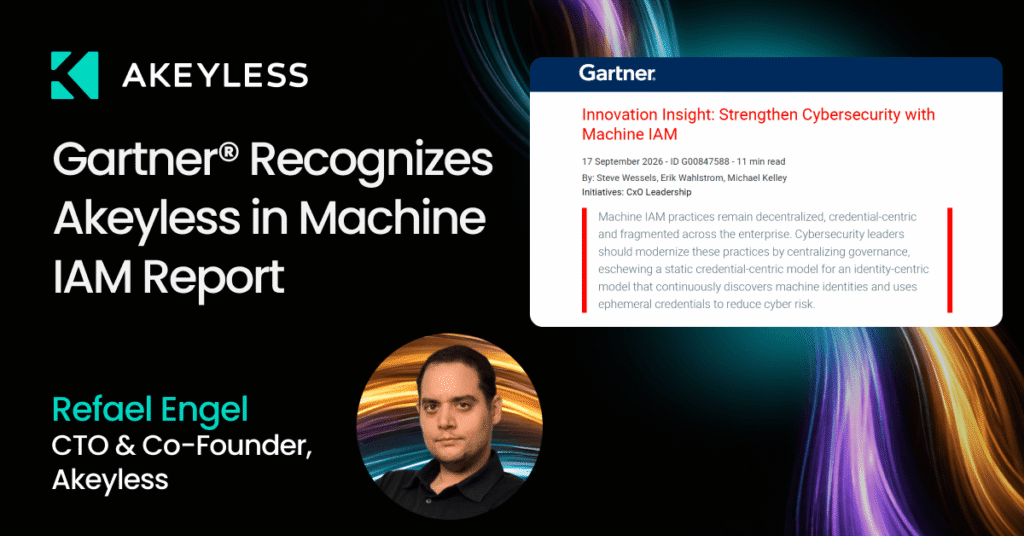
On 17 September 2026, Gartner published Innovation Insight: Strengthen Cybersecurity with Machine IAM, a research note for CISOs. Its message is direct: the way enterprises manage machine identities today is credential-centric and fragmented, and attackers are exploiting the gap.

Akeyless is named a Representative Provider in the report. The research provides useful guidance for any security leader responsible for workloads or autonomous agents. It points toward a different control model: govern the machine identity itself, then issue access dynamically based on policy.

Human IAM Creates a Structural Mismatch for Machine Identities

Traditional IAM was built around people. Users sign in interactively, hold relatively stable roles, and have their access reviewed on a predictable schedule. Machine identities do not follow that pattern.

Workloads authenticate programmatically and may exist for only minutes. Their access can change as applications are deployed or infrastructure changes. AI agents add another complication because they can act autonomously with delegated authority.

Gartner found that 47% of organizations still attempt to govern machine identities through broad IAM policies designed for human users. The consequences are already measurable: 58% of surveyed organizations reported cybersecurity incidents involving AI-linked and non-AI machine identities, with business disruption, financial loss, and reputational damage among the outcomes. And while 71% of organizations are increasing IAM spending, many still lack basic capabilities such as machine identity discovery and risk assessment.

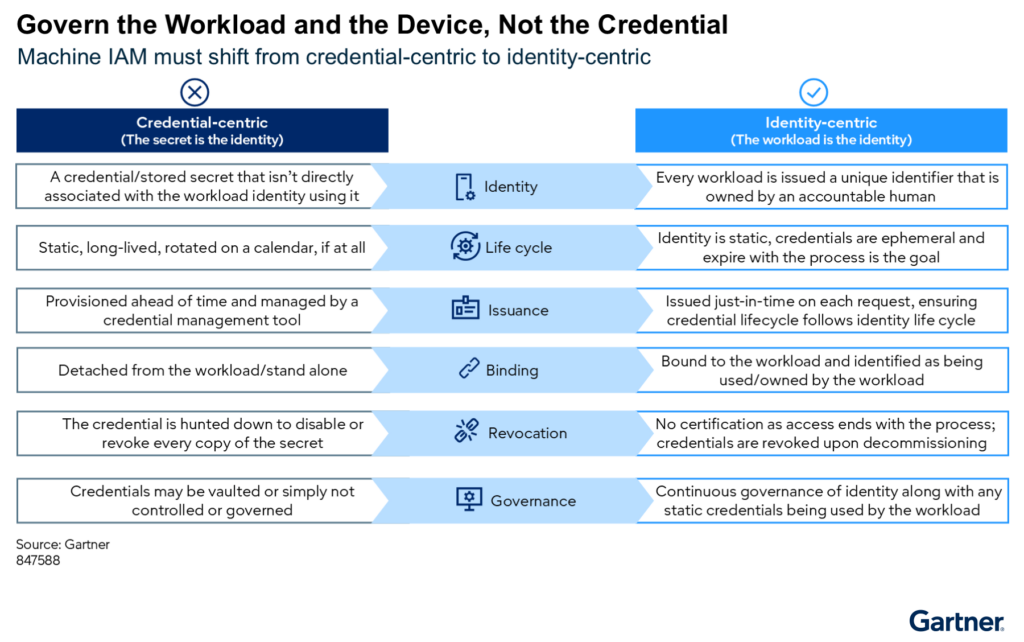
Gartner’s prescription is a shift from credential-centric to identity-centric machine IAM.

Gartner
“Cybersecurity leaders should shift from credential-centric to identity-centric machine IAM. This shift replaces static secrets with managed workload identities and ephemeral or just-in-time (JIT) access.”

Gartner®, Innovation Insight: Strengthen Cybersecurity with Machine IAM, Steve Wessels, Erik Wahlstrom, Michael Kelley, 17 September 2026

That changes the control model. Instead of treating a static secret as the identity, security teams authenticate the workload itself and issue short-lived access based on policy. The core controls become the identity, its owner, its purpose, and the conditions under which access should exist.

Machine IAM Moves the Control Point From Credentials to Identity

Gartner’s report frames the change clearly: security teams need to govern the workload itself, not just the credential it happens to use. In an identity-centric model, each machine has its own identity, ownership, purpose, and policy context. Access can then be issued only when needed and removed when that need ends.

A credential can be rotated, replaced, or revoked, but those actions alone do not tell you which workload is using it, why that workload needs access, or whether the access still matches its current purpose. Machine IAM has to preserve that context as infrastructure changes.

This continues a shift Gartner was already describing earlier this year. In April, we wrote about Gartner research spanning Workload Access Management, Multi-Vault Governance, and Workload Identity Management. That research pointed toward fewer long-lived secrets, stronger workload identity, and centralized governance across environments where multiple credential systems already coexist.

→ Read our earlier analysis of Gartner’s workload IAM architecture

Five Directions Gartner Sets Out

Paraphrasing the report’s recommendations:

  • Replace static service accounts with managed workload identities and use short-lived, least-privilege, just-in-time credentials wherever possible.
  • Maintain a living inventory of machines and AI agents, with a unique identifier, accountable human owner, business purpose, defined permissions, and documented lifecycle.
  • Govern AI agents as high-risk workloads, with dedicated registration, a human sponsor, scoped permissions, session limits, approved model versions, and expiring credentials.
  • Assess existing platforms before adding another point tool, identifying capability gaps and opportunities to consolidate machine identity governance.
  • Centralize machine IAM governance through a cross-functional working group with clearly defined accountability across security, identity, infrastructure, cloud, application development, and business teams.
AI Agents Push Machine IAM Into Runtime

Gartner’s Machine IAM report treats AI agents as high-risk workloads and calls for tighter controls around their identities, permissions, and delegated authority. Additional research on AI agent security by Gartner, SACR, and other industry experts extends that thinking into runtime. SACR’s ARISE framework, in particular, focuses on runtime identity security and enforcement for autonomous agents..

That creates a further requirement for machine IAM beyond the scope of this report. Security teams need to govern who the agent is and what it can access, while also controlling whether the actions it takes remain within the authority it was given.

How Akeyless Maps to Gartner’s Machine IAM Direction

Gartner’s recommendations describe an operating model that combines workload identity, short-lived access, lifecycle governance, and tighter controls for AI agents. The Akeyless Identity Security Platform secures secrets, machine identities, privileged access, certificates, and encryption keys for humans, machines, and AI agents through a single SaaS control plane, with customer-hosted Gateways for private connectivity and Zero-Knowledge operation.

Gartner DirectionHow Akeyless Delivers It
Short-lived, JIT credentials instead of static secretsDynamic Secrets are minted on demand with minimal permissions and a TTL, then destroyed. Rotated Secrets cover systems that cannot yet go dynamic. Zero Standing Privileges by default.
A secretless model for workloadsUniversal Identity and native authentication for AWS IAM, Azure, GCP, Kubernetes, OIDC, and SPIFFE let workloads authenticate as themselves instead of presenting a stored secret.
A central control plane for revocationOne policy model and one audit trail across clouds, Kubernetes, SaaS, and on-premises. Revoke an identity once and it is enforced everywhere the Gateway brokers access.
AI agents governed as high-risk workloadsAkeyless applies identity, scoped access, expiring credentials, and audit controls to AI agents in line with Gartner’s guidance. Agentic Runtime Authority extends those controls into execution by brokering actions through the Gateway, enforcing intent-aware policy, and keeping credentials out of the agent.
Platform convergence over point toolsSecrets management, Modern PAM, certificate lifecycle, key management, workforce password management, and AI agent security in one platform and one codebase.
Protecting runtime tokensCredentials are generated inside the customer Gateway and never travel with the workload. Akeyless DFC™ (Distributed Fragments Cryptography®) means no whole key or master key exists anywhere, including at Akeyless.

Why This Matters Now

Gartner makes the stakes clear: AI agents are turning machine IAM from an infrastructure problem into a business risk. In Akeyless’s 2026 State of AI Agent Identity Security report, 84% of respondents said their AI agents can access sensitive data. That means weak identity governance can translate directly into exposure, disruption, and audit risk.

As machine IAM capabilities converge, security teams have less reason to manage workload identity, secrets, certificates, and agent access as separate programs. The priority is to establish one governable model for machine authority before AI adoption pushes fragmentation even further.

Next steps

Gartner clients can read the full Innovation Insight: Strengthen Cybersecurity with Machine IAM on gartner.com.

Akeyless brings workload identity, short-lived access, machine identity governance, and runtime control for autonomous agents together in one Identity Security Platform. If you are moving away from static credentials or preparing AI agents for production, request a demo and we will walk through the Akeyless architecture against your environment.

Gartner does not endorse any company, vendor, product or service depicted in its publications, and does not advise technology users to select only those vendors with the highest ratings or other designation. Gartner publications consist of the opinions of Gartner’s business and technology insights organization and should not be construed as statements of fact. Gartner disclaims all warranties, expressed or implied, with respect to this publication, including any warranties of merchantability or fitness for a particular purpose.


Frequently Asked Questions

What is machine IAM?

Machine IAM is the practice of managing identity, authentication, authorization, ownership, and lifecycle controls for non-human actors such as applications, workloads, services, devices, and AI agents. Gartner describes machine IAM as covering identities, credentials, authorization policies, attribution, ownership tracking, and granular access controls.

How is machine IAM different from secrets management?

Secrets management protects credentials such as passwords, API keys, certificates, and tokens. Machine IAM is broader: it governs the identity using those credentials, including who owns it, what it is allowed to access, why that access exists, and when it should be changed or retired.

Why are AI agents considered machine identities?

AI agents authenticate and act programmatically rather than requiring a human to perform each action. Gartner includes AI agents within machine IAM and recommends treating autonomous agents as high-risk workloads with defined permissions, accountable ownership, session controls, and expiring credentials.

How does Akeyless support machine IAM?

Akeyless supports machine IAM by combining workload identity, short-lived access, secrets management, privileged access, certificate lifecycle management, and AI agent security in one Identity Security Platform. It also extends machine identity controls into runtime for autonomous agents through Agentic Runtime Authority.

Why are short-lived credentials important for machine identities?

Short-lived credentials reduce how long stolen or exposed access can remain useful. Gartner recommends moving away from static service accounts where possible and using ephemeral or just-in-time credentials as part of an identity-centric machine IAM model.

Related Resources

View all
Illustration of a secretless AI agent using Akeyless runtime authority
Blog How We Put Zero-Secret AI Agents to Work

Summary: Secretless access and runtime authorization are important concepts in AI agent security, but what do they look like in practice? At Akeyless, we…

November 15, 2026
  • G2 Fall 2026 Leader — Non-Human Identity Management
  • G2 Fall 2026 Momentum Leader — Privileged Access Management
  • G2 Fall 2026 High Performer — Certificate Lifecycle Management
  • G2 Fall 2026 Easiest To Do Business With — Secrets Management
  • G2 Fall 2026 Easiest To Use — Privileged Access Management, Enterprise
  • G2 Fall 2026 Best Support — Privileged Access Management, Enterprise









