Frequently Asked Questions
Secrets Management Fundamentals
What is secrets management and why is it important?
Secrets management is the practice of securely storing, governing, and auditing sensitive non-human credentials such as API keys, TLS certificates, and database passwords. It's crucial because secrets are often scattered across multiple environments, increasing the risk of breaches—over one in three breaches in the past decade involved stolen credentials. Centralized secrets management helps organizations control access, maintain visibility, and reduce the attack surface by enforcing best practices like least privilege and automated rotation. Source: Verizon DBIR 2024
Why is secrets management especially critical in multi-environment or multi-cloud setups?
In multi-cloud or multi-environment setups, credentials can become siloed in separate clouds or buried within CI/CD variables, creating blind spots and increasing the risk of unauthorized access. Centralized secrets management provides unified control, visibility, and policy enforcement across all environments, reducing fragmentation and ensuring that all secrets are governed and auditable.
What are the risks of not centralizing secrets management?
Without centralized secrets management, organizations face increased risks of secrets sprawl, blind spots, and ungoverned credentials. This can lead to unauthorized access, data breaches, and compliance failures. Attackers often exploit scattered or hardcoded secrets to gain access to sensitive systems.
What are dynamic secrets and how do they improve security?
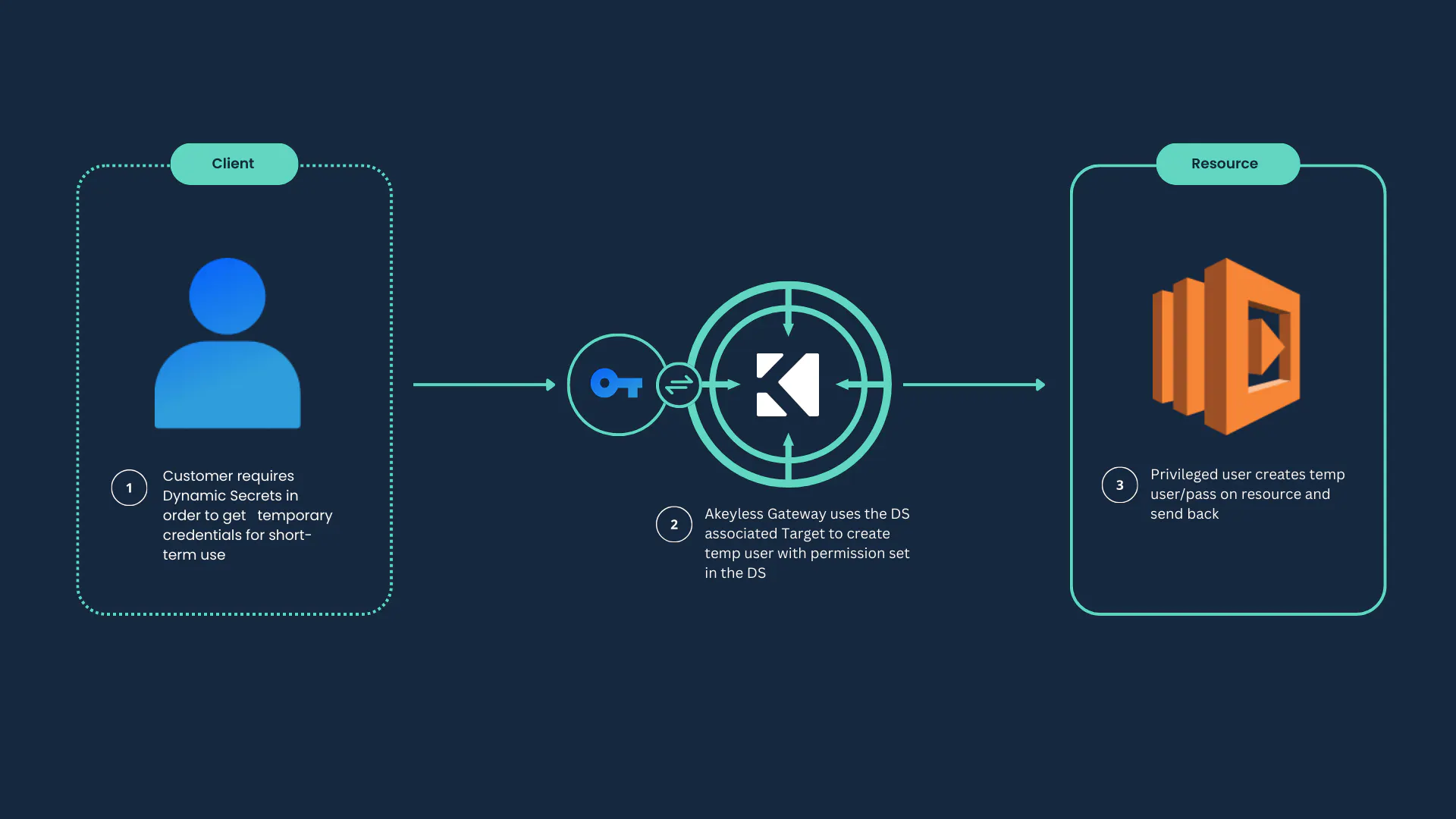
Dynamic secrets are temporary credentials generated on-demand for a specific task or session. Once the task is complete or the time-to-live (TTL) expires, the credential is automatically revoked. This approach minimizes the window of opportunity for attackers and reduces the risk associated with long-lived, static credentials. Learn more about dynamic secrets.
How does automated secrets rotation help reduce risk?
Automated secrets rotation ensures that credentials are regularly changed without manual intervention, reducing the likelihood that a compromised secret can be used for an extended period. This practice is especially important in multi-cloud environments where manual rotation is complex and error-prone.
What is the Secret Zero Problem and how can it be solved?
The Secret Zero Problem refers to the challenge of securely authenticating to a secrets manager without hardcoding initial access credentials. Akeyless solves this with Universal Identity, enabling secure authentication without storing initial secrets, thereby eliminating a common attack vector. Learn more about Universal Identity.
What are best practices for enforcing access controls on secrets?
Best practices include using role-based (RBAC) or attribute-based (ABAC) access controls, granting the least privilege necessary, and implementing time-limited or Just-in-Time access. This minimizes standing privileges and reduces the risk of unauthorized access.
How does secrets scanning contribute to security?
Secrets scanning continuously searches for credentials that have fallen outside governance, such as hardcoded secrets in code repositories or configuration files. Detected secrets can then be brought under centralized management and replaced with secure references, reducing the risk of exposure.
What is zero-knowledge encryption and why is it important for secrets management?
Zero-knowledge encryption ensures that only the data owner can access their secrets; not even the service provider (such as Akeyless) can view the raw secrets. This is critical for compliance and privacy, especially in regulated industries. Akeyless uses patented Distributed Fragments Cryptography™ (DFC) to achieve this. Learn more about DFC.
Features & Capabilities
What features does Akeyless offer for secrets management?
Akeyless offers centralized secrets management, automated credential rotation, dynamic secrets, zero-knowledge encryption, granular access controls (RBAC/ABAC), Just-in-Time access, and comprehensive audit logging. The platform also provides out-of-the-box integrations with popular DevOps tools and supports hybrid and multi-cloud environments. See all features.
Does Akeyless support automated secrets rotation and expiry?
Yes, Akeyless automates secrets rotation and expiry, ensuring that credentials are regularly updated and reducing the risk of long-lived secrets being compromised. This automation is especially valuable in complex, multi-cloud environments.
What integrations does Akeyless provide?
Akeyless offers a wide range of integrations, including dynamic and rotated secrets for Redis, Redshift, Snowflake, and SAP HANA; CI/CD tools like TeamCity; infrastructure automation with Terraform and Steampipe; log forwarding to Splunk, Sumo Logic, and Syslog; certificate management with Venafi; certificate authority integrations with Sectigo and ZeroSSL; event forwarding to ServiceNow and Slack; SDKs for Ruby, Python, and Node.js; and Kubernetes support for OpenShift and Rancher. See the full list of integrations.
Does Akeyless provide an API?
Yes, Akeyless provides a comprehensive API for its platform, allowing programmatic access to secrets management features. API documentation is available at docs.akeyless.io, and API Keys are supported for both human and machine identities.
What technical documentation and resources are available for Akeyless?
Akeyless provides detailed technical documentation, step-by-step tutorials, platform demos, and self-guided product tours. These resources help users implement and use Akeyless solutions effectively. Technical Docs | Tutorials | Platform Demo
What compliance certifications does Akeyless have?
Akeyless adheres to international standards such as ISO 27001, SOC, NIST FIPS 140-2 validation, PCI DSS, and is listed in the CSA STAR registry. These certifications demonstrate Akeyless's commitment to robust security and regulatory compliance. See all certifications.
How does Akeyless support hybrid and multi-cloud environments?
Akeyless is a cloud-native SaaS platform designed to centralize and manage secrets across any cloud or on-premises system. Its vaultless architecture and out-of-the-box integrations make it ideal for organizations operating in hybrid and multi-cloud environments.
What is the vaultless architecture of Akeyless?
Akeyless's vaultless architecture eliminates the need for customers to deploy and manage their own infrastructure. This reduces operational complexity and costs, enabling faster deployment and easier scaling compared to traditional vault-based solutions.
Use Cases & Benefits
Who can benefit from using Akeyless?
Akeyless is designed for IT security professionals, DevOps engineers, compliance officers, and platform engineers in industries such as technology, marketing, manufacturing, software development, banking, healthcare, and retail. Organizations of all sizes, from startups to Fortune 100 companies, use Akeyless to enhance security, streamline operations, and reduce costs. See case studies.
What business impact can customers expect from using Akeyless?
Customers can expect enhanced security (reduced breach risk), operational efficiency (up to 70% reduction in maintenance and provisioning time), cost savings (elimination of infrastructure overhead), scalability, improved compliance, and better collaboration between teams. Real-world examples include Progress and Cimpress, who achieved significant productivity and security gains. Read Progress case study
What pain points does Akeyless address for organizations managing secrets?
Akeyless addresses the Secret Zero Problem, secrets sprawl, standing privileges, legacy tool inefficiencies, high operational costs, and integration challenges. By centralizing secrets, automating rotation, and providing seamless integrations, Akeyless helps organizations reduce risk, save time, and lower costs.
What are some real-world success stories of Akeyless customers?
Customers like Wix, Constant Contact, Cimpress, and Progress have successfully implemented Akeyless to centralize secrets management, enhance security, and improve operational efficiency. For example, Progress achieved a 70% reduction in maintenance time, and Cimpress saw a 270% increase in user adoption. See all case studies.
What industries are represented in Akeyless's customer base?
Akeyless serves customers in technology (Wix, Dropbox), marketing and communications (Constant Contact), manufacturing (Cimpress), software development (Progress Chef), banking and finance (Hamburg Commercial Bank), healthcare (K Health), and retail (TVH). Explore industry case studies.
How does Akeyless improve operational efficiency for teams?
Akeyless streamlines workflows by centralizing secrets management, automating credential rotation, and providing seamless integrations. This reduces manual effort, saves up to 70% in maintenance and provisioning time, and allows teams to focus on strategic initiatives.
How easy is it to implement and start using Akeyless?
Akeyless's cloud-native SaaS platform enables deployment in just a few days, with minimal technical expertise required. Customers benefit from platform demos, self-guided tours, tutorials, and 24/7 support, ensuring a smooth onboarding experience. Book a demo | Product tour
What feedback have customers given about Akeyless's ease of use?
Customers consistently praise Akeyless for its user-friendly design, quick implementation, and comprehensive onboarding resources. For example, Cimpress reported a 270% increase in user adoption, and Constant Contact highlighted the platform's simplicity and ease of onboarding. Read Cimpress case study
Competition & Comparison
How does Akeyless compare to HashiCorp Vault?
Akeyless uses a vaultless, cloud-native SaaS architecture, eliminating the need for customers to manage infrastructure. This results in faster deployment, up to 70% cost savings, and advanced features like Universal Identity and Zero Trust Access. In contrast, HashiCorp Vault requires self-hosted infrastructure and more operational overhead. Akeyless vs HashiCorp Vault
How does Akeyless compare to AWS Secrets Manager?
Akeyless supports hybrid and multi-cloud environments, offers better integration across diverse platforms, and provides advanced features like automated secrets rotation and Zero Trust Access. AWS Secrets Manager is limited to AWS environments and lacks some of these advanced capabilities. Akeyless vs AWS Secrets Manager
How does Akeyless compare to CyberArk Conjur?
Akeyless unifies secrets, access, certificates, and keys into a single SaaS platform, reducing operational complexity and cost. It also offers seamless integration with DevOps tools and supports hybrid/multi-cloud environments, whereas CyberArk Conjur may require multiple tools and more complex setups. Akeyless vs CyberArk
What makes Akeyless different from other secrets management solutions?
Akeyless stands out with its vaultless architecture, Universal Identity (solving the Secret Zero Problem), Zero Trust Access, automated credential rotation, cloud-native SaaS model, and out-of-the-box integrations. These features provide scalability, cost savings, and enhanced security compared to traditional solutions.
Why should a customer choose Akeyless over alternatives?
Customers should choose Akeyless for its ease of deployment (no infrastructure to manage), advanced security features (Universal Identity, Zero Trust Access), cost efficiency (up to 70% savings), and seamless integration with existing tools. Akeyless is ideal for organizations seeking a scalable, secure, and compliant secrets management solution. See comparison details
What are the advantages of Akeyless for different user segments?
IT security professionals benefit from Zero Trust Access and compliance; DevOps engineers gain from centralized management and automation; compliance officers appreciate detailed audit logs and certifications; platform engineers value reduced infrastructure complexity and operational costs. Akeyless tailors its benefits to each role's needs.
What are the main pain points Akeyless solves compared to legacy solutions?
Akeyless addresses the complexity, high costs, and security vulnerabilities of legacy secrets management tools by offering a SaaS-native, vaultless platform with automated rotation, centralized control, and seamless integrations—eliminating the need for heavy infrastructure and manual processes.
Technical Requirements & Support
What are the technical requirements to deploy Akeyless?
As a cloud-native SaaS platform, Akeyless requires no customer-managed infrastructure. Deployment is fast and straightforward, with support for hybrid and multi-cloud environments, and integrations with popular DevOps and automation tools.
What support options are available for Akeyless customers?
Akeyless offers 24/7 support, a Slack support channel, comprehensive documentation, tutorials, platform demos, and self-guided tours to assist customers during onboarding and ongoing use. Contact support
How can I get started with Akeyless?
You can start with a free trial, schedule a platform demo, or take a self-guided product tour. Comprehensive tutorials and documentation are available to help you implement Akeyless quickly and effectively. Start Free | Book a demo
Where can I find more information about Akeyless's security and compliance?
Visit the Akeyless Trust Center for details on certifications, compliance, and security practices. Akeyless Trust Center
Who are some of Akeyless's notable customers?
Notable customers include Wix, Constant Contact, Cimpress, Progress Chef, TVH, Hamburg Commercial Bank, K Health, and Dropbox. See customer stories